It all started with a phone call.
“My brother-in-law Frank Hocken, now in his 80’s, has led an incredible life. He and my sister Lee are very successful entrepreneurs, and through their business interests have achieved so much together. They were instrumental in retaining and developing Twizel – the South Island town that was constructed as the base for the largest hydro project ever undertaken in New Zealand. Post the project, the temporary town was going to be discarded – demolished. It made no sense. Frank and Lee could see the potential. They took risks, garnered support, challenged the Council and eventually won the case to retain and develop the town. Since then, the town that was close to being destroyed, has been transformed whilst still retaining its charm. The population has grown and given its location, surrounded by beautiful mountains and lakes, it’s a destination of choice for thousands of holiday makers year-round. You’ll have to go and see for yourself. Frank is an amazing storyteller and it’s so important their story is captured for family and friends”.
We met Frank and Lee Hocken a few weeks later. His sister-in-law was spot on when she said Frank was a great storyteller. Handing over a box of notes, some newspaper cuttings and a couple of books we chatted about his early life. Intrigued, we agreed to read the notes and consider the project. It soon became apparent that Frank and Lee’s story was astonishing. Frank was a force to be reckoned with in business, most notably, but not limited to property and community development. It was evident that Frank and Lee’s family, achievements, and business interests, were not restricted to Twizel. Their story, their legacy, would need to be preserved, documented, and read to be believed.
Franks Way – The Story of Frank and Lee Hocken, is an inspirational story of hard work, adversity, and determination. With our one-on-one support and guidance, we had the privilege of capturing this couple’s life journey from their humble origins in rural New Zealand. They met each other on the other side of the world and returned to New Zealand to start a new life together. Their story is full of interesting accounts of family life, business success and failures, and includes their role in the history of the retention of Twizel, the small hydro town that refused to die. While they have business interests all over New Zealand, Twizel has remained central to their family life and business for more than 30 years.
With a nudge from a sibling, Frank and Lee bravely took up the challenge and invested the time to preserve their living legacy.

Working at their own pace, and in their own way, they initially compiled their story for family, friends, and future generations. It’s an enduring finished product that they are proud to share with others. But clearly their documented story is bigger than that; Franks Way – The Story of Frank and Lee Hocken is a significant accomplishment.
Their story shows how they and their family have shaped our environment, and in so doing, they have made an enormous contribution to New Zealand’s social and cultural heritage.
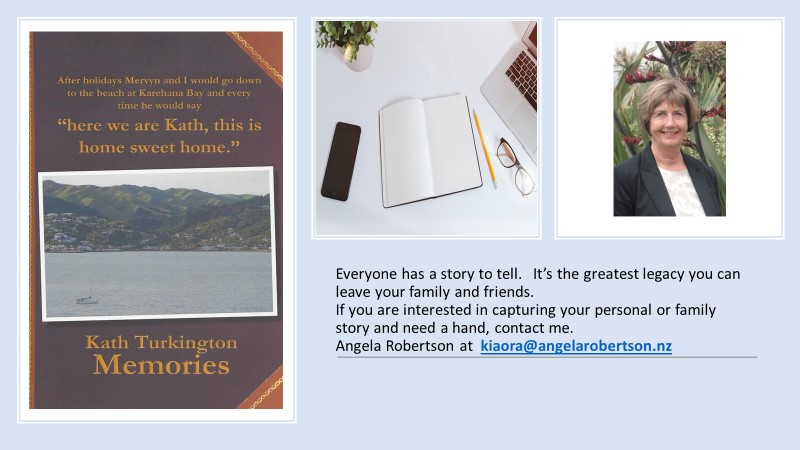
Your story matters. It’s a gift to be treasured. Don’t let it go untold. We appreciate everyone’s story if different. For example, it could be a collection of memories, a career or business story, a family history, a travel adventure, or a spiritual journey. Whatever it is take the first step towards preserving your story for your loved ones. Documenting it doesn’t need to be a laborious solitary experience. One-on-one personalised, confidential support, tailored to your needs, is available every step of the way – from concept to completion. This includes project initiation, guidance on structure, writing structure, writing assistance, and final presentation including publishing options for those that are keen to take this step. Schedule your complimentary consultation today to get started on your legacy project.
Email me at Kiaora@angelarobertson.nz
Testimonials
“I am so very, very grateful for all the amazing work you have done – how you assisted me through the whole process to share my story, compile my chapters, and helped me to advertise and launch my book ‘The Ever-Widening Circles’. I am overwhelmed with praise. Thank you.” – Marg Schrader
“Angela was willing to help us put our stories together. I am very grateful for all her help over the months of meeting together, typing up my handwritten notes, inserting my photos, and compiling the chapters for printing.” – Andy Higham ‘My Thoughts…My Life’
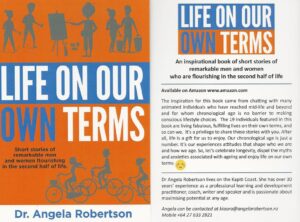
Angela Robertson is a writer, inspirational speaker and workshop facilitator. Her own non-fiction books are available in paperback, Kindle and eBook formats from online bookstores. Amazon.com: Angela Robertson: Books, Biography, Blog, Audiobooks, Kindle